Prototype printing
Print to answer the next question.
A prototype is most useful when you know what you want to learn. Separate a shape sample, a fit check and a presentation model before choosing the route.
Choose what the prototype needs to show
For a shape sample, identify the proportions and handling questions. For a fit check, give the mating geometry and critical dimensions. For a presentation model, mark the visible face and acceptable surface texture. A single prototype may not answer all three questions equally well.
FDM, large-format FDM and resin are available within our 20+ printer fleet. Choose a process around the learning goal and the real geometry. The FDM/resin comparison helps frame that decision; a process name alone is not evidence of final-use performance.
Keep the iteration traceable
Name the model revision and separate changed features from unchanged ones. Record the observation you need to make after the physical sample arrives. If the purpose is to test an interface, avoid simultaneously changing that interface and the surrounding features without a reason: it becomes harder to understand which change helped.
The prototype-development guide explains a staged learning approach. The prototype brief gives a compact handoff format for one iteration.
Agree what happens after the sample
Decide whether the result will lead to another prototype, a modified file or a small run. Do not treat a screen preview or illustrative picture as proof of a physical result. For design changes, use file and model advice before ordering the next revision.
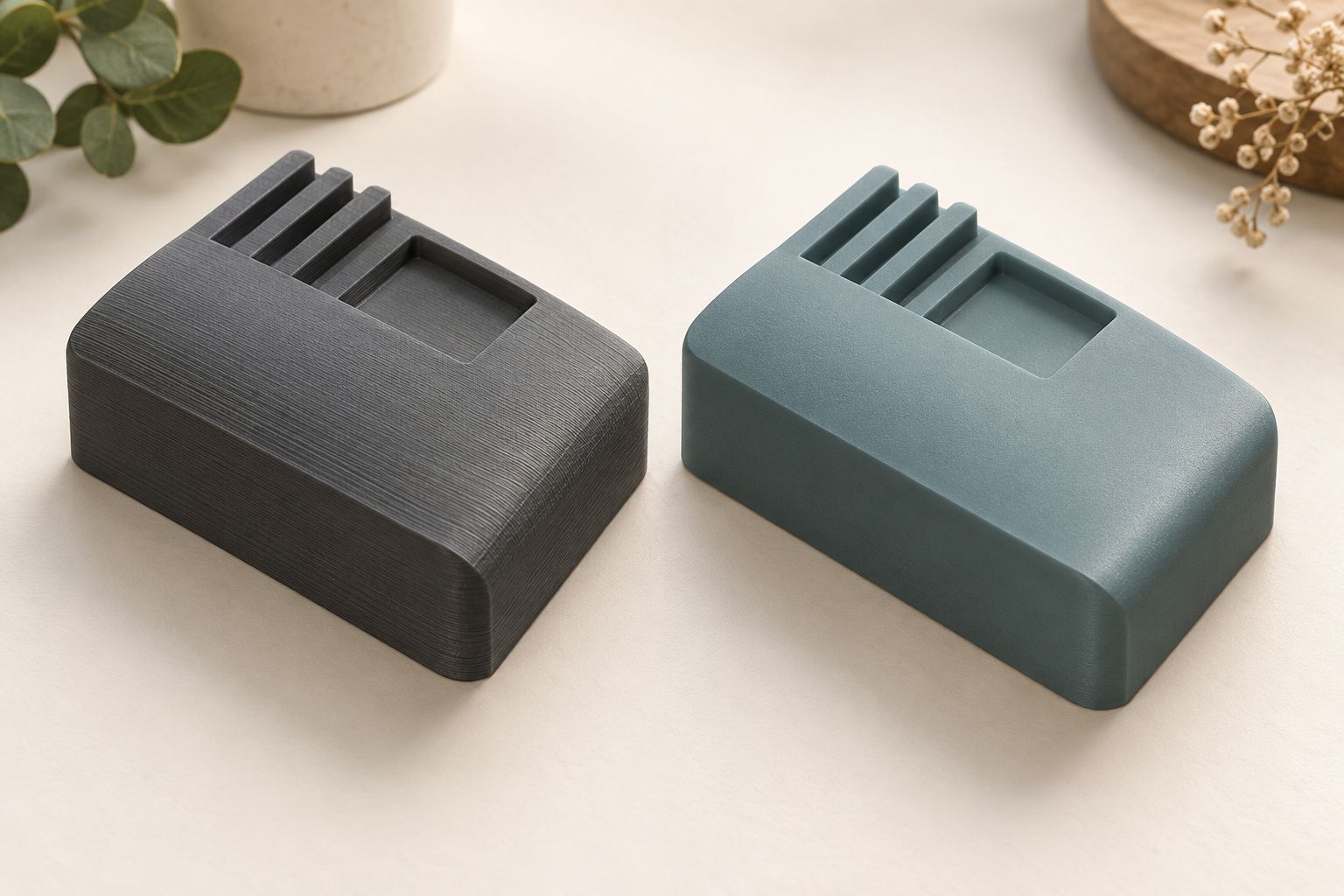
The fictional finish-priority study below explores a presentation decision. It is not a customer case study or evidence that the pictured part has been printed.
Quote the actual iteration
Include quantity, units, overall dimensions and the question this revision should answer. Use instant quoting for its current choices or a manual enquiry for an unlisted process, finishing requirement or involved brief. Printing operates seven days a week; delivery is the only fulfilment route, with the job’s schedule confirmed separately.
Hypothetical design study / fictional brief
A finish-priority sample
An independently invented teaching example. No customer project is depicted, and this concept has not been printed, measured or validated as part of this study.
- Priority face. Mark the broad face the viewer will see; agree acceptable texture or further finishing.
- Ribs and recess. Review actual dimensions. The illustration provides no dimensional proof.
- Support discussion. Identify faces where contact may be acceptable. No verified orientation is shown.
The fictional brief
Assume three indoor presentation samples, each roughly 80 × 50 × 12 mm. An original rounded block has a broad, slightly curved face, three raised ribs and a shallow recess. Its shape and small details should be visible. These dimensions and quantities are illustrative, not an order or a capacity claim.
The decision
Which face matters most, and what texture is acceptable? Name the presentation face before choosing a process. Review the ribs and recess against the actual model rather than assuming the picture proves their printability.
One route with FDM
Filament printing could be considered if layer texture suits the presentation. Discuss how orientation balances the main face with support elsewhere. A surface formed above supports can look different, so improving one face may introduce a trade-off on another. Prusa surface guidance
Another route with resin
Resin could be considered where fine detail is the priority. Support contact may leave marks, and washing and any required post-curing belong to the chosen material's workflow. The particular resin and finishing scope need confirming. Formlabs support marks, finishing guidance
There is no measured, cheapest or strongest winner here. The illustrated textures are artistic cues, not output from our fleet.
Before manufacture
Confirm the model revision, units, feature dimensions, quantity, visible-face priority, acceptable support contact, available material and agreed finishing. Define the acceptance check. A display-only assumption is not a fit or strength assessment.
What to send
Send a dimensioned view and a screenshot marking the priority face. Say whether layers are acceptable and whether finishing is essential or optional. The finish brief gives a more precise vocabulary.
Use instant quoting for the available choices, a manual enquiry for unlisted requirements or model advice before quoting geometry that needs changes.
Have a question about your project?
[email protected]